Request Samples

This site is intended for US Healthcare Professionals only.

This site is intended for US Healthcare Professionals only.

FINE-ONE: A landmark phase 3 clinical trial evaluating KERENDIA in patients with T1D and CKD1,3

Trial Design

Icon of a kidney and blood drop

THE FIRST TREATMENT APPROVED FOR YOUR ADULT PATIENTS WITH CKD ASSOCIATED WITH T1D IN 30+ YEARS1,2 
KERENDIA reduces UACR, which is expected to slow CKD progression1,3

FINE-ONE: A landmark phase 3 clinical trial evaluating KERENDIA in adults with CKD and T1D1,3

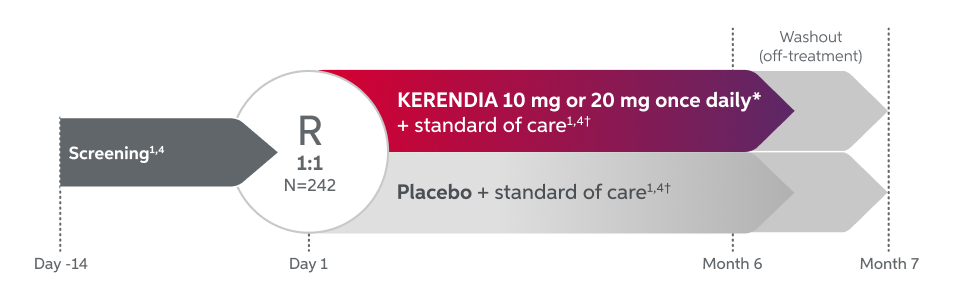
In FINE-ONE, a randomized, double-blind, placebo-controlled trial, the efficacy and safety of KERENDIA were evaluated when added to a stable dose of an ACEi or ARB in adults with CKD associated with T1D.1,3

FINE-ONE study design with KERENDIA and placebo treatment groups

Primary outcome: efficacy1

Change in UACR from baseline over 6 months (averaged over Months 3 and 6)1

Key criteria and baseline characteristics

Select inclusion criteria1,5:
  • Age ≥18 years
  • Type 1 diabetes
  • Continuously treated with insulin
  • HbA1c at screening <10.0%
  • UACR ≥200-<5000 mg/g
  • eGFR ≥25-<90 mL/min/1.73 m2
  • On a stable dose of ACEi or ARB
  • Serum potassium level ≤4.8 mEq/L
Select exclusion criteria1,5:
  • Mean BP >160/100 mmHg or mean systolic BP <90 mmHg at screening
  • Hospitalization due to a CV event ≤4 weeks prior to screening
  • Symptomatic heart failure with reduced ejection fraction with class 1A indications for MRAs
  • Current or previous (≤8 weeks prior to screening) treatment with a SGLT-2/1i or GLP-1RA
Select baseline patient characteristics1,6:
  • Mean age: 51.6 ± 13.7
  • Male: 65.3%
  • BMI, kg/m2, mean ± SD: 27.6 ± 6.0
  • Systolic BP, mmHg: 135.2 ± 16.7
  • eGFR, mL/min/1.73 m2, mean ± SD: 58.8 ± 19.1
  • UACR, mg/g, median (IQR): 549 (298.8-1190.7)
  • Serum [K+], mmol/L, mean: 4.6 ± 0.4
  • HbA1c, %, mean‡: 7.6 ± 1.1
  • Duration of diabetes, years, mean: 32.0 ± 14.2
  • CVD§: 59 (24.4)
  • Hypertension: 85.5%
  • ACEi or ARBs: 99.2%
  • Diuretics: 36.0%
  • Beta blockers: 27.3%
  • Statins: 73.6%
  • Platelet aggregation inhibitorsII: 31.4%

*For participants with an eGFR ≥25 to <60 mL/min/1.73 m2, starting dose was 10 mg od. For participants with an eGFR ≥60 mL/min/1.73 m2, starting dose was 20 mg od. Up-titration from 10 mg to 20 mg was permitted from Month 1 onward based on serum potassium and eGFR. Dose reduction was allowed at any time for safety reasons.1,3†Patients were required to be taking a stable dose of an ACEi or ARB as standard of care.1‡Values missing for 2 participants.6§History of CVD was determined by the presence of one of the following in the medical history: myocardial infarction, coronary artery stenosis, cerebrovascular accident, transient ischemic attack, peripheral arterial occlusive disease or cardiac failure.6IIExcluding heparin.6

ACEi=angiotensin-converting enzyme inhibitor; ARB=angiotensin receptor blocker; BMI=body mass index; BP=blood pressure; CKD=chronic kidney disease; CV=cardiovascular; CVD=cardiovascular disease; eGFR=estimated glomerular filtration rate;
GLP-1RA=glucagon-like peptide-1 receptor agonist; HbA1c=glycated hemoglobin; IQR=interquartile range; [K+]=potassium concentration; MRA=mineralocorticoid receptor antagonist; R=randomization; SD=standard deviation; SGLT-2/1i=sodium-glucose cotransporter-2/1 inhibitor; T1D=type 1 diabetes; UACR=urine albumin-to-creatinine ratio.

INDICATIONS:

KERENDIA (finerenone) 10 mg, 20 mg tablets is indicated to:

  • reduce the risk of sustained estimated glomerular filtration rate (eGFR) decline, end-stage kidney disease, cardiovascular death, non-fatal myocardial infarction, and hospitalization for heart failure in adult patients with chronic kidney disease (CKD) associated with Type 2 diabetes (T2D)
  • reduce urinary albumin-to-creatinine ratio (UACR), which is expected to reduce the risk of sustained estimated glomerular filtration rate (eGFR) decline and end-stage kidney disease in adults with CKD associated with Type 1 diabetes (T1D)

IMPORTANT SAFETY INFORMATION

CONTRAINDICATIONS:

  • Hypersensitivity to any component of this product
  • Concomitant use with strong CYP3A4 inhibitors
  • Patients with adrenal insufficiency

WARNINGS AND PRECAUTIONS:

  • Hyperkalemia: KERENDIA can cause hyperkalemia. The risk for developing hyperkalemia increases with decreasing kidney function and is greater in patients with higher baseline potassium levels or other risk factors for hyperkalemia. Measure serum potassium and eGFR in all patients before initiation of treatment with KERENDIA and dose accordingly. Do not initiate KERENDIA if serum potassium is >5 mEq/L.

    Measure serum potassium periodically during treatment with KERENDIA and adjust dose accordingly. More frequent monitoring may be necessary for patients at risk for hyperkalemia, including those on concomitant medications that impair potassium excretion or increase serum potassium.

MOST COMMON ADVERSE REACTIONS:

  • The adverse reactions reported in ≥1% of patients on KERENDIA and more frequently than placebo were hyperkalemia (14% vs 6.9%), hypotension (4.6% vs 3%), and hyponatremia (1.3% vs 0.7%).

DRUG INTERACTIONS for KERENDIA 10 mg, 20 mg:

  • Strong CYP3A4 Inhibitors: Concomitant use of KERENDIA with strong CYP3A4 inhibitors is contraindicated. Avoid concomitant intake of grapefruit or grapefruit juice.
  • Moderate and Weak CYP3A4 Inhibitors: Monitor serum potassium during drug initiation or dosage adjustment of either KERENDIA or the moderate or weak CYP3A4 inhibitor, and adjust KERENDIA dosage as appropriate.
  • Strong and Moderate CYP3A4 Inducers: Avoid concomitant use of KERENDIA with strong or moderate CYP3A4 inducers.

USE IN SPECIFIC POPULATIONS:

  • Lactation: Avoid breastfeeding during treatment with KERENDIA and for 1 day after treatment.
  • Hepatic Impairment: Avoid use of KERENDIA in patients with severe hepatic impairment (Child Pugh C) and consider additional serum potassium monitoring with moderate hepatic impairment (Child Pugh B).
Please see the full Prescribing Information for KERENDIA.